A stainless steel wall kitchen mixer starts with a plan on the wall rather than on the counter. A deck-mounted tap needs only a hole in the sink or worktop. A wall mixer needs two inlet positions, a height and a spout length that all agree with the sink below, and those numbers are set before the tiler arrives. The SP372, a single lever model with a Φ35mm cartridge, shows how these choices fit together.
Inlet spacing and mounting height
Wall kitchen mixers are commonly sized by the distance between the two inlets, and the 8" listing on the SP372 gives installers the number they need for the rough-in. Once the two supply pipes are fixed at that spacing, the position of the whole fixture is settled. A stainless steel wall kitchen mixer cannot be moved a few centimetres after tiling the way a deck tap can, so the plumber and the kitchen designer usually agree on the spacing on the drawing.
Height comes next. A common planning range puts the spout outlet roughly 200 to 300mm above the sink rim. That is high enough for a large pot to slide under the spout, and low enough that the stream does not scatter on the bowl. A wall-mounted kitchen tap set too low makes it hard to fill tall containers, and one set too high splashes the backsplash.
On a stainless steel wall kitchen mixer, the lever sits above the spout, so its own swing has to clear the wall and any shelf or window frame beside it. On the SP372, the lever moves in a vertical and sideways arc, and a clear zone of about a hand width around the body keeps the movement free.
Spout reach over the sink.
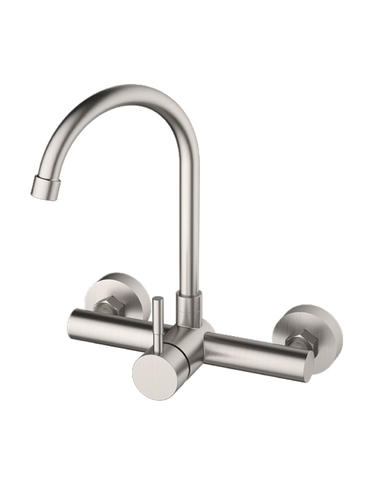
Reach is the distance from the wall to the point where water lands. The stream should fall near the centre of the sink bowl, so the spout length follows the bowl depth. In a shallow single bowl a longer spout works, and in a narrow double bowl kitchen, a shorter one keeps the stream over the drain instead of over the dividing ledge. A stainless steel wall kitchen mixer with a fixed spout gives a predictable landing point, which helps designers who work from a standard sink size.
Reach also affects daily use. When the spout is long enough to sit over the bowl, wet hands and dishes stay inside the sink area, and the counter behind stays dry. A wall-mounted kitchen tap also removes the tap base from the counter, so the worktop runs straight to the wall without a raised fixture to wipe around.
Tile, backsplash and cleaning
A stainless steel wall kitchen mixer meets the tile directly, so the pipe depth matters. The inlet connectors are set so the wall plates sit flush with the finished tile face, and the tile thickness is measured before the pipes are fixed. When the depth is right, the plates cover the tile cut edges neatly and the joint stays tight against the wall.
Cleaning is a practical reason kitchens choose wall fixtures. With no base sitting on the counter, water cannot pool around a deck plate, and a cloth can pass along the backsplash in one movement. The stainless steel wall kitchen mixer body itself is one material throughout, so the surface finish is a matter of polishing or brushing rather than a coating. A brushed surface hides light water marks and fingerprints better than a mirror polish, which suits family kitchens where the tap is touched many times a day.
Planning a wall mixer range
Buyers building a kitchen collection around a stainless steel wall kitchen mixer can look at three points together: inlet spacing, spout length and finish. The SP372 uses the same Φ35mm cartridge size as the brass models, so a retailer can offer wall and deck mixers with a matching lever feel. Handle style, spout length and packaging can be adjusted for private label projects, and the finish can be chosen to match sinks and appliances in the same range.
Designers working on open kitchens with wall-hung shelving often prefer a wall-mounted kitchen tap because it keeps the counter line clear. Commercial kitchens use the same layout for another reason, since a wall fixture leaves the sink deck free for the work surface. In both cases, a stainless steel wall kitchen mixer works well when the drawing lists the spacing, the height and the spout reach together, so the plumber, the tiler and the fitter all work from one set of numbers. When that plan is in place, a stainless steel wall kitchen mixer goes on the wall in one visit.