Bathroom design is moving toward cleaner surfaces and more coordinated fixture placement. For residential developments, hotels, and renovation projects, the basin area must accommodate the faucet, plumbing, storage, and daily washing activities without creating unnecessary visual congestion. An In Wall Basin Mixer changes this arrangement by placing the main mixer body behind the wall while keeping the spout and control components visible.
This installation approach makes the faucet part of the wall design rather than a separate fitting positioned on the basin or countertop. Its value depends on how accurately the fixture, basin, wall structure, and water connections are coordinated before installation.
Wall-Mounted Installation Changes Available Space
A conventional basin mixer normally occupies a position on the basin deck or countertop. An In Wall Basin Mixer uses a concealed installation arrangement, leaving fewer components around the washing area.
This layout can help designers create a more open countertop and maintain clearer lines around the basin. It may also suit bathrooms where the basin is positioned close to a wall or where the project requires a minimalist appearance. However, the space-saving effect depends on the complete installation plan rather than the visible faucet alone.
The wall thickness, concealed body, water connections, and finished wall surface all influence the final position of the fitting. A suitable In Wall Basin Mixer must therefore be considered together with the basin and surrounding bathroom structure.
Spout Projection Must Match Basin Dimensions
The spout position determines where water enters the basin. If the outlet is too close to the rear wall, water may fall near the basin edge. If it projects too far forward, the water stream may create unnecessary splashing or reduce the usable space above the bowl.
For an In Wall Basin Mixer, the spout height and projection should correspond to the basin’s depth, rim height, and shape. Countertop basins, integrated basins, and under-counter basins can create different installation conditions, so the same faucet arrangement may not suit every basin type.
The position of the outlet also affects cleaning and daily operation. A correctly coordinated spout can direct water toward the appropriate area of the bowl while leaving enough room for users to wash their hands comfortably.
Concealed Connections Require Early Planning
The main installation difference between a deck-mounted faucet and an In Wall Basin Mixer appears before the wall is completed. The concealed body and water connections need to be positioned during the plumbing and wall preparation stages.
The installation drawing should account for the finished wall thickness, basin height, spout projection, and control position. If these dimensions are not coordinated early, the visible trim may sit too far forward or too far back, while the water outlet may fail to align with the basin.
For construction teams, the faucet specification should be reviewed alongside the basin drawing and wall structure. The visible spout and lever cannot be treated as independent components because their final position depends on the concealed installation body.
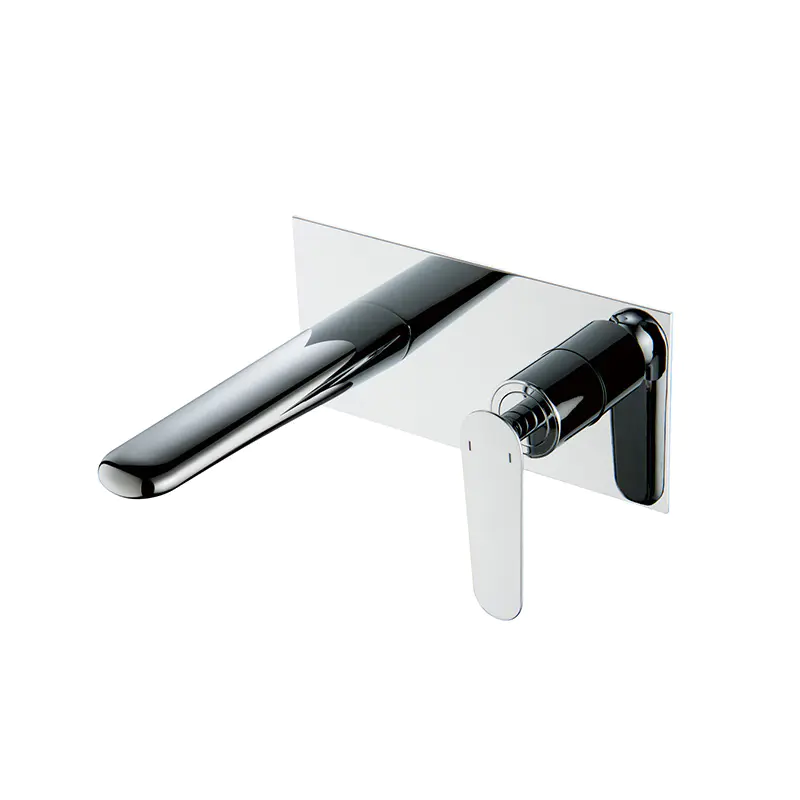
Single-Lever Control Supports Compact Operation
Zhendi’s ZD35-02 is listed as a single-lever built-in wall basin mixer with a 35mm configuration. Its single-lever arrangement combines water flow and temperature control in one visible component.
This structure is relevant to an In Wall Basin Mixer because the wall-mounted layout provides less flexibility for changing the control position after installation. The lever should be placed where users can reach it without leaning across the basin or placing their hands directly under the water stream.
The control position also affects the visual balance of the wall. A lever placed too close to the spout may make the fitting appear crowded, while excessive separation can make the arrangement look disconnected. The installation plan needs to consider both operating clearance and appearance.
Visible Finish Influences Fixture Coordination
Although concealed installation is the main structural feature, the visible finish remains important in bathroom projects. The spout and control are often positioned against a prominent wall surface, so their shape and finish can influence the appearance of the entire basin area.
An In Wall Basin Mixer may be coordinated with other bathroom fittings, including shower mixers, bath taps, drains, and accessories. For distributors supplying complete bathroom collections, consistent finishes and related design details can help maintain a unified product range.
The visible components should also suit the selected basin and wall materials. A compact fitting may work well with a simple basin design, while a more substantial basin may require a different spout proportion and installation position.
Manufacturing Accuracy Supports Installation Fit
The concealed body, wall trim, spout, and control lever of an In Wall Basin Mixer must function as one assembly. Dimensional accuracy affects how these components connect and how the finished fitting sits against the wall.
Zhendi’s basin mixer range includes single-handle and double-handle models, as well as brass and stainless steel options. The company integrates product development, production, and testing within its sanitary ware manufacturing operations.
For an In Wall Basin Mixer, consistent component dimensions are especially important because the finished appearance depends on the relationship between several parts. Accurate connections, stable assembly, and suitable surface finishing help the fitting match the planned installation arrangement.
The use of an In Wall Basin Mixer is therefore not simply a choice between two faucet styles. It is a decision that affects basin positioning, wall preparation, plumbing coordination, user access, and the appearance of the finished bathroom.